
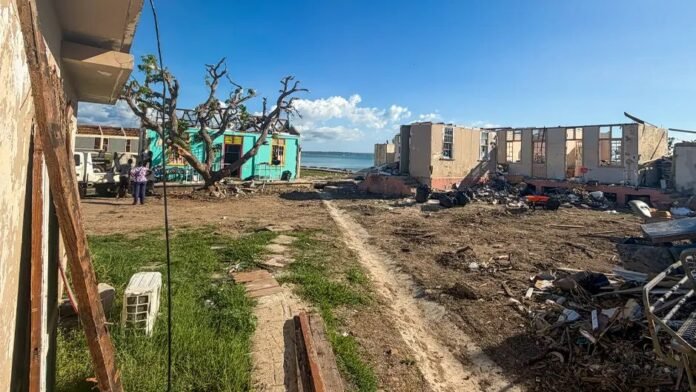

Healing Jamaica: A Journey of Hope After Hurricane Melissa
As Dr. Pytregay Thompson’s plane descended over Jamaica, she felt a wave of nostalgia mixed with heartbreak. The vibrant island she once knew, filled with lush trees and colorful fruits, was now marred by the aftermath of Hurricane Melissa. Instead of the familiar green landscape, all she could see were blue tarps and the skeletal remains of trees. “I wasn’t prepared,” she admitted, reflecting on the devastation that had swept through her homeland.
Dr. Thompson, a pediatric resident at the University of Miami, returned to Jamaica not just to witness the destruction but to help. She joined a team from the Miller School’s Global Institute for Community Health and Development, which aimed to support local healthcare providers overwhelmed by the storm’s impact. Over two weeks, she treated 50 to 60 young patients daily at clinics in northwestern Jamaica, witnessing firsthand the health challenges that arose from the disaster.
“Being able to help patients in Hanover reminded me why I pursued medicine,” Thompson shared. The lack of clean water led to a surge in skin infections and gastrointestinal issues, a stark reminder of the struggles faced by many Jamaicans. Despite the emotional toll, she found purpose in her work, knowing she was making a difference.
Hurricane Melissa, one of the strongest storms on record, struck in late October, claiming at least 45 lives and leaving communities in ruins. In response, Jamaican health officials reached out to the Global Institute for assistance. Dr. Elizabeth Greig, co-director of the institute, emphasized the importance of this collaboration. “Sending these doctors back to Jamaica was a great opportunity for us,” she said. “It helps alleviate the burden on local doctors and allows our residents to reconnect with their families.”
Alongside Thompson, Dr. Shanice Spence-Miller and Dr. Kathryn Swaby also returned to their roots to aid recovery efforts. Spence-Miller was shocked by the extent of the destruction in her hometown. “Entire communities were gone,” she recalled, noting the flattened concrete homes and the eerie silence where bustling towns once thrived. At Savanna-La-Mar Public General Hospital, she treated patients suffering from chronic conditions and infections exacerbated by the hurricane’s aftermath.
Despite the overwhelming challenges, Spence-Miller found hope in the resilience of her fellow Jamaicans. “There was a strong sense of gratitude,” she noted. “That spirit is what I want people to remember about Jamaica.” She emphasized the need for sustained investment in healthcare and education to support long-term recovery.
The Global Institute is not new to disaster response. In 2010, they coordinated a field hospital in Haiti after a major earthquake, and in 2019, they assisted the Bahamas following Hurricane Dorian. Greig hopes the efforts in Jamaica will mirror the success seen in the Bahamas, providing both immediate relief and long-term support.
As the team works to establish telemedicine connections and child-friendly learning spaces, the focus remains on rebuilding. “Getting safe learning spaces reestablished for children is critical,” said Dr. Kendra Van Kirk, highlighting the importance of education in recovery.
While Hurricane Melissa left a heavy toll, both Thompson and Spence-Miller are optimistic about Jamaica’s future. “We will get back to our lush, green, beautiful country,” Thompson affirmed. “It will take time, but we are who we are, and we will get back to the people we were meant to be.”
In the face of adversity, the spirit of Jamaica shines through, reminding us all of the power of community and resilience. How can we, as a global community, continue to support this journey of recovery?