

The Gender Funding Gap in African Startups: A Closer Look
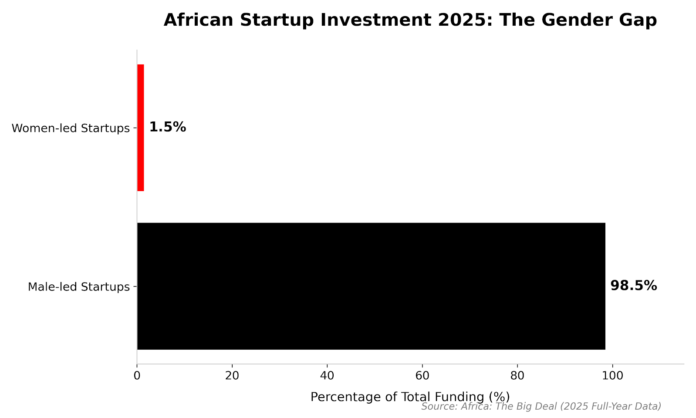
Women-led startups in Africa are facing a significant challenge in securing venture capital, despite a broader recovery in the continent’s startup investment landscape. According to the Africa Investment Report 2025 by Briter, less than 10% of all venture funding in Africa went to companies with at least one female founder. This statistic highlights the persistent gender-based disparities in capital allocation, even as overall investment activity shows signs of improvement.
The Landscape of Startup Funding
In 2025, African startups raised approximately $3.8 billion across more than 630 deals, marking an increase in deal volumes year-on-year. However, this capital is heavily concentrated among a small group of late-stage companies and specific sectors, limiting the benefits for women-led ventures. Adesuwa Okunbo Rhodes, founder of Aruwa Capital Management, emphasized that only 2% of capital is currently directed toward female businesses in Africa. This stark reality suggests that investing in women-led startups could yield some of the best opportunities, especially when the market is less saturated.
The Exclusion from Mega-Deals
Briter’s report reveals that women founders are particularly excluded from large funding rounds. Mega-deals, defined as transactions of $50 million and above, accounted for about a quarter of all disclosed funding in 2025. Unfortunately, these lucrative deals were predominantly captured by male-led or male-dominated teams, reinforcing gender gaps at the scale-up stage. The report underscores that the gender funding gap is not merely a short-term anomaly but a structural issue rooted in various barriers.
Barriers to Accessing Capital
Several factors contribute to the challenges faced by women entrepreneurs in accessing funding. Limited access to investor networks, lower risk tolerance from investors toward women-led ventures, and the concentration of capital in sectors like fintech, energy, and mobility—where female founders are underrepresented—are significant hurdles. While women-led startups are more visible in early-stage sectors such as education, health, and agriculture, their ability to scale remains constrained. Median deal sizes for early-stage companies were relatively low in 2025, and securing follow-on funding proved difficult as investors prioritized established revenue models.
Financing Pressures on Women Entrepreneurs
A complementary report from Moniepoint titled “Funding Nigeria’s Women-Owned Businesses” sheds light on the financing pressures faced by women entrepreneurs. It found that 40.2% of women rely on personal funds and savings to start or sustain their businesses, while 59.8% seek external financing, often from family and friends. Despite these efforts, a financing gap of 32% persists, with women entrepreneurs less likely to secure funding or receiving smaller ticket sizes compared to their male counterparts. This gap becomes even more pronounced as businesses grow, further entrenching the underrepresentation of women in later-stage funding rounds.
The Role of Policy and Institutional Reforms
Industry stakeholders argue that policy and institutional reforms are crucial for closing the gender funding gap. Fifehan Osikanlu, founder of Eden Venture Group, advocates for supportive government policies to improve access to capital for female-led businesses in Nigeria. Osasu Igbinedion-Ogwuche, founder of TOS Group, emphasizes the role of banks in easing access to credit. She points out that collateral requirements are a significant barrier preventing women from accessing loans. With about 95% of Nigerian women demonstrating creditworthiness by repaying loans on time, there is a pressing need for policymakers and financial institutions to recognize this and implement solutions that enable women to grow their businesses.
Geographic and Sectoral Concentration
Briter’s analysis also highlights geographic and sectoral concentration as compounding factors in the funding landscape. The so-called “Big Four” ecosystems—Nigeria, Kenya, South Africa, and Egypt—continue to dominate funding flows, leaving women founders in frontier and breakout markets facing even steeper barriers to capital access. This concentration not only limits opportunities for women entrepreneurs but also stifles innovation and diversity in the startup ecosystem.
Alternative Financing Instruments
Despite the bleak picture of equity funding, the rise of alternative financing instruments, including grants, debt, and blended finance, offers a potential pathway to broaden access for women entrepreneurs. However, analysts caution that without deliberate intervention from investors, limited partners, and policymakers, equity capital is unlikely to rebalance organically. Sarah Ngamau, managing director and partner at Moremi Fund, stresses the need for bold target-setting by large funds to drive meaningful change. She advocates for audacious targets at both fund and portfolio levels, including increasing the number of female partners and allocating more carry to women.
The Recovery of Startup Funding
Separate data from Africa: The Big Deal indicates that total startup funding across equity, debt, and grants (excluding exits) rose to $3.2 billion in 2025, a 40% increase from $2.2 billion in 2024. This rebound followed consecutive declines after funding fell from about $3.1 billion in 2023 due to global monetary tightening and valuation corrections. Yet, this recovery has done little to alter the structural imbalances shaping Africa’s venture capital landscape. For women-led startups, the funding rebound has reinforced existing inequalities rather than narrowing them, raising concerns about the inclusivity of Africa’s next growth cycle.
In summary, while the African startup ecosystem shows signs of recovery, the gender funding gap remains a pressing issue that requires urgent attention and action. Addressing these disparities is not only a matter of equity but also essential for fostering a more innovative and diverse entrepreneurial landscape across the continent.